New Year Trading Goals That Actually Work: A SMART Framework for 2026
Learn how to set trading goals that you'll actually achieve. This comprehensive guide uses the SMART framework to help traders create meaningful, measurable goals for the new year.
Profabighi Capital Research Team
January 1, 2026
Important Notice
This content is provided for informational and educational purposes only. It should not be considered as financial, investment, or trading advice.

Introduction: Why Most Trading Resolutions Fail
It's January 1st. You're motivated. Inspired. Ready to make this your best trading year ever.
You write down your goals:
- "Be more disciplined"
- "Make more money"
- "Stop revenge trading"
- "Follow my plan"
Sound familiar?
Here's the problem: these aren't goals. They're wishes.
And wishes don't come true just because the calendar changed.
I know this because I've been there. For years, I made the same vague resolutions every January. And by February, I had forgotten them entirely.
But three years ago, I discovered a framework that changed everything. It's called SMART goals, and when applied to trading, it transforms vague wishes into achievable outcomes.
The Problem: Why Vague Goals Don't Work
Let's be honest about why most trading resolutions fail:
1. They're Not Specific
"Be more disciplined" means nothing. Disciplined about what? When? How?
2. They're Not Measurable
"Make more money" sounds great, but how much? Compared to what?
3. They're Outcome-Focused, Not Process-Focused
"Stop revenge trading" focuses on what you DON'T want to do, not what you WILL do instead.
4. There Are Too Many
When everything is a priority, nothing is a priority.
5. They Rely on Willpower
"Just be disciplined" assumes you'll always have the willpower to make the right choice. You won't.
"People do not decide their futures, they decide their habits and their habits decide their futures." — F.M. Alexander

The SMART Framework for Traders
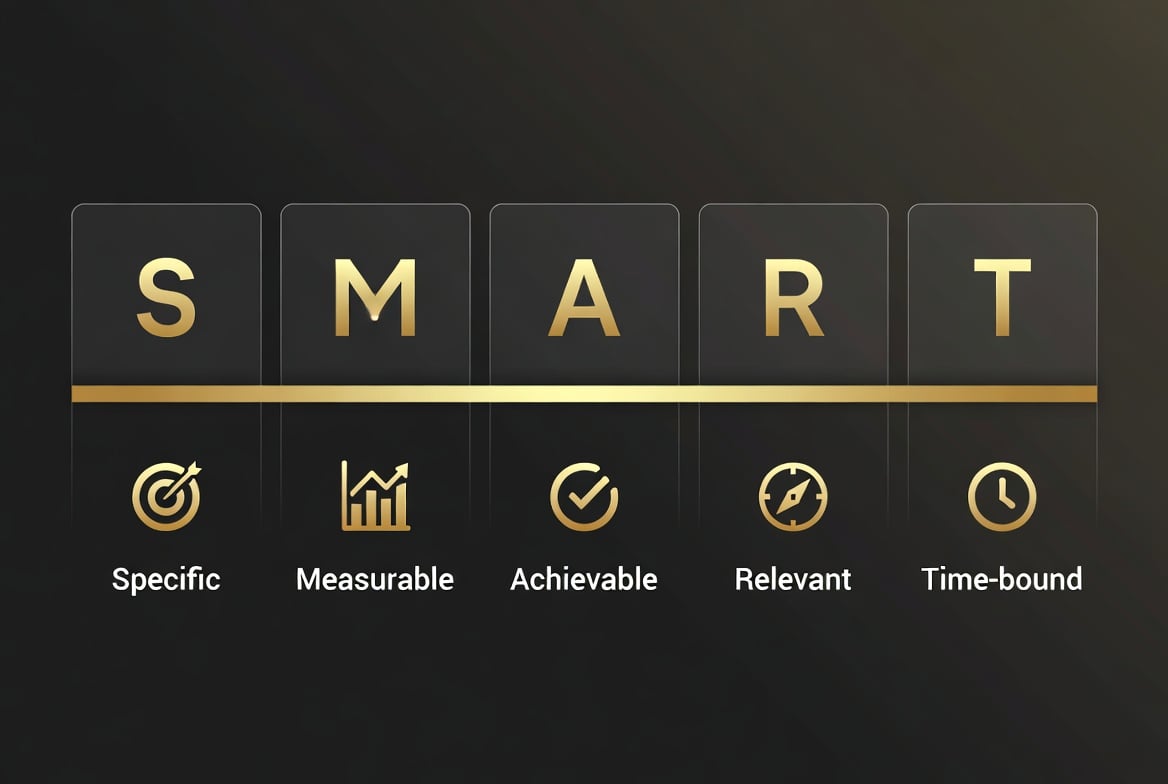
SMART is an acronym that transforms vague wishes into achievable goals:
- Specific: What exactly will you do?
- Measurable: How will you track progress?
- Achievable: Is this realistic given your situation?
- Relevant: Does this align with your trading goals?
- Time-bound: When will you achieve this?
Transforming Vague Goals into SMART Goals
Example 1: Discipline
Vague Goal: "Be more disciplined"
SMART Goal: "I will follow my pre-trade checklist before every trade for the next 90 days, tracking my adherence in my trading journal with a simple yes/no."
Example 2: Risk Management
Vague Goal: "Manage risk better"
SMART Goal: "I will risk no more than 1% of my account per trade for Q1 2026, reviewing my position sizing weekly every Sunday."
Example 3: Revenge Trading
Vague Goal: "Stop revenge trading"
SMART Goal: "After any losing trade, I will take a 30-minute break before my next trade. I will track this in my journal and aim for 90% adherence over the next 60 days."
Process Goals vs. Outcome Goals
Here's a crucial distinction most traders miss:
Outcome Goals focus on results you can't fully control:
- "Make $50,000 this year"
- "Achieve 60% win rate"
- "Double my account"
Process Goals focus on actions you CAN control:
- "Follow my trading plan on every trade"
- "Review my journal every Sunday"
- "Take a break after every losing trade"
The paradox? Focusing on process goals leads to better outcomes than focusing on outcome goals.
Why? Because you can't control the market. But you CAN control whether you follow your rules.
The One Goal Rule
If I could give you one piece of advice, it would be this:
Choose ONE primary goal for the year.
Not five. Not ten. One.
Why? Because focus is a superpower. When you have one clear goal, every decision becomes easier.
How to Choose Your One Goal:
Ask yourself:
- What is the ONE thing that, if improved, would have the biggest impact on my trading?
- What mistake do I keep making that costs me the most?
- What habit, if built, would solve multiple problems?
For most traders, the answer falls into one of these categories:
- Risk management (position sizing, stop losses)
- Emotional control (revenge trading, FOMO)
- Plan adherence (following rules, journaling)
Pick one. Master it. Then move to the next.

Building Systems, Not Relying on Willpower
Here's the truth about willpower: it's a limited resource.
You wake up with a certain amount of willpower. Every decision depletes it. By the end of the day, you have less willpower than you started with.
This is why you make your worst trading decisions in the afternoon.
The solution? Build systems that don't require willpower.
System Examples:
Instead of: "I'll be disciplined about position sizing"
Build this system: Create a position size calculator that automatically tells you how many shares/contracts to buy.
Instead of: "I'll stop revenge trading"
Build this system: Set a rule that after 2 consecutive losses, you're done for the day. No exceptions.
Instead of: "I'll journal more"
Build this system: Create a 5-question template that takes 2 minutes to complete.
Systems remove the need for willpower. They make the right choice the default choice.
Profabighi Capital's Goals for 2026
At Profabighi Capital, we practice what we preach. Here's our ONE goal for 2026:
Primary Goal (The ONE Thing):
"Scale our fully automated trading systems to generate consistent, hands-free returns across multiple asset classes — zero emotions, pure data, systematic precision."
Supporting Process Goals:
- System Expansion: Deploy more automated strategies across forex, crypto, and equities
- Algorithm Optimization: Continuously refine our quantitative models based on real market data
- Community Growth: Release more free TradingView indicators to help traders worldwide
- Transparency: Share real backtest results and performance metrics with our community
Outcome Goal (For Direction):
"Build institutional-grade automated systems accessible to retail traders, proving that data-driven algorithmic trading delivers consistent results."
This is what Profabighi Capital stands for: Wisdom Beyond Algorithms. We're not just teaching you to trade — we're building the systems that trade for you.

The 90-Day Sprint
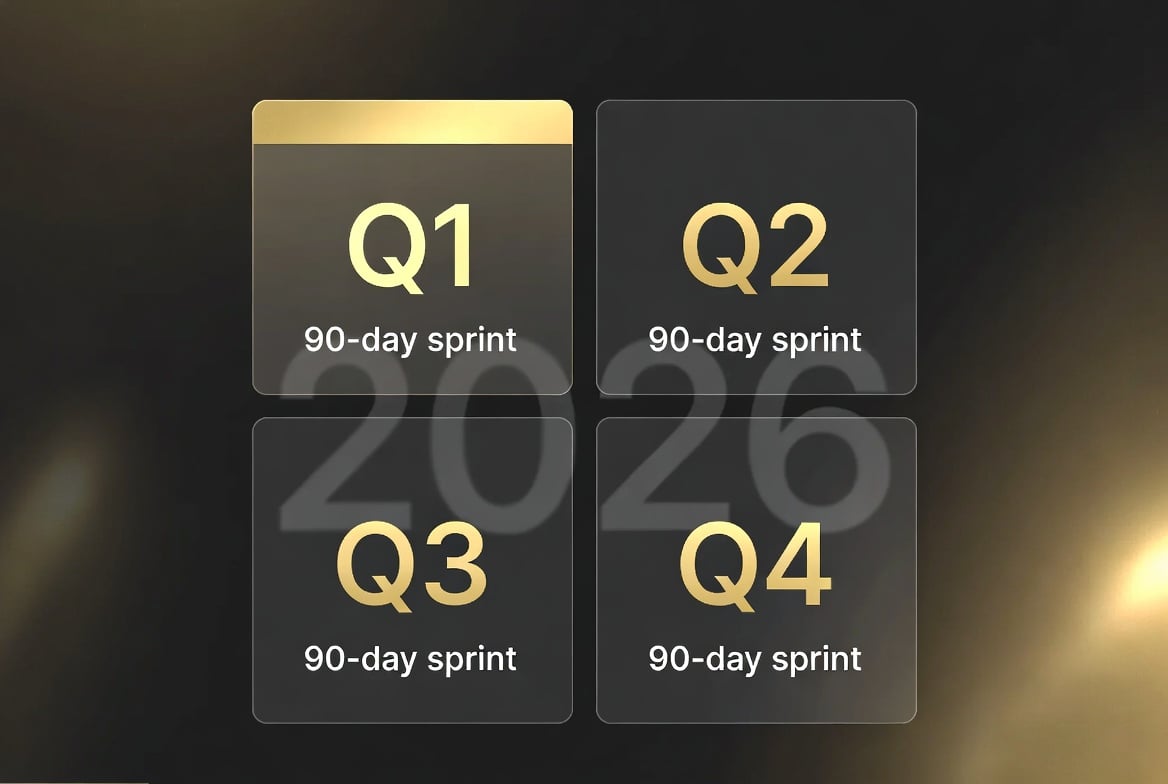
Here's a practical tip: don't think in years. Think in 90-day sprints.
A year is too long. You'll lose motivation by March.
Instead:
- Set your annual direction (where do you want to be in December?)
- Break it into 90-day sprints (what will you focus on this quarter?)
- Review and adjust every 90 days
Q1 2026 Sprint Example:
Focus: Building the journaling habit
SMART Goal: "I will complete my trading journal within 5 minutes of every trade for 90 days, achieving 90% adherence."
Weekly Check-in: Every Sunday, review adherence and adjust if needed.
End of Sprint: Evaluate. Did I hit 90%? What worked? What didn't?
Common Mistakes to Avoid
Mistake 1: Setting Too Many Goals
The problem: Scattered focus leads to scattered results.
The solution: Choose ONE primary goal.
Mistake 2: Focusing Only on Outcomes
The problem: You can't control outcomes, only actions.
The solution: Set process goals you can control.
Mistake 3: No Tracking System
The problem: What gets measured gets managed.
The solution: Create a simple tracking system.
Mistake 4: No Accountability
The problem: It's easy to let yourself off the hook.
The solution: Share your goals with someone.
Mistake 5: All-or-Nothing Thinking
The problem: Missing one day feels like failure.
The solution: Aim for 90% adherence, not 100%.
Key Takeaways
- Vague goals fail - "Be more disciplined" isn't a goal, it's a wish
- Use the SMART framework - Specific, Measurable, Achievable, Relevant, Time-bound
- Process over outcomes - Focus on what you can control
- One goal beats ten - Choose ONE primary focus
- Systems beat willpower - Build habits that don't require motivation
- Think in 90-day sprints - A year is too long to maintain focus
- Track everything - What gets measured gets managed
Your Action Plan
Before you close this article, do this:
- Write down your ONE primary goal for 2026 using the SMART framework
- Identify 3-5 process goals that support it
- Create a simple tracking system (journal, spreadsheet, app)
- Set a weekly review time (I recommend Sunday mornings)
- Share your goal with someone for accountability
FAQ Section
What is an example of a trading goal?
A good trading goal is specific and measurable. For example: "I will risk no more than 1% of my account per trade for Q1 2026, tracking my position sizes in my trading journal weekly."
What are some good goals to set for the new year?
For traders, the best goals focus on process rather than outcomes. Examples include: following your trading plan on every trade, completing a trading journal after each trade, taking breaks after losing trades, and conducting weekly performance reviews.
What is the 3 5 7 rule in trading?
The 3-5-7 rule is a risk management guideline suggesting you risk no more than 3% on any single trade, keep total exposure under 5% of your account, and ensure winning trades are at least 7% larger than losing trades.
How do I discipline myself as a trader?
Discipline comes from systems, not willpower. Build habits that make the right choice the default: use a pre-trade checklist, set automatic position sizing rules, take mandatory breaks after losses, and track your adherence in a journal.
What is the 90-90-90 rule for traders?
The 90-90-90 rule states that 90% of traders lose 90% of their money in the first 90 days. The solution is proper education, risk management, and realistic expectations before trading with real money.
Conclusion
The new year is a fresh start. But a fresh start means nothing without intentional action.
Don't make the same vague resolutions you made last year. Don't rely on willpower that will fade by February.
Instead, set ONE clear goal. Make it SMART. Build systems to support it. Track your progress. And give yourself grace when you fall short.
Make 2026 the year you stop wishing and start achieving.
From all of us at Profabighi Capital, we wish you a successful and disciplined new year.