The Patience Principle: Why Trading Less Makes You More Money
Master trading patience with our quality-over-quantity framework. Learn setup grading, overcome overtrading, and discover why the best traders trade less.
Profabighi Capital Research Team
January 19, 2026
Important Notice
This content is provided for informational and educational purposes only. It should not be considered as financial, investment, or trading advice.

The best trading months often have the fewest trades. The worst trading months often have the most.
This counterintuitive truth points to one of the most underrated edges in trading: patience.
This guide explores why trading less typically produces better results, and provides a practical framework for developing patience as a trading skill.
The Hidden Cost of Overtrading
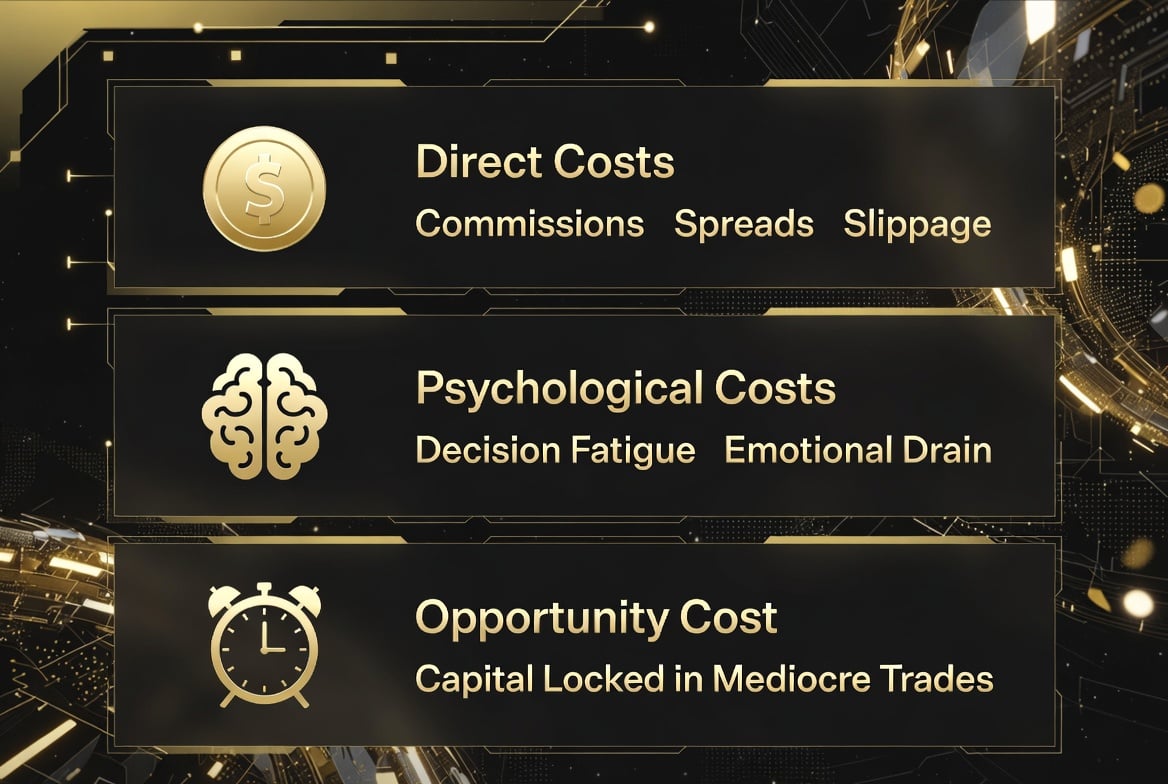
Every trade carries costs—some visible, some hidden.
Direct Costs
Commissions: Even at low rates, frequent trading accumulates significant commission expenses over time.
Spreads: The bid-ask spread is a hidden tax on every entry and exit. More trades mean more spread costs.
Slippage: The difference between intended price and actual fill. More trades mean more slippage events.
Psychological Costs
Decision Fatigue: Every trade requires multiple decisions—entry, sizing, management, exit. More trades mean more decisions, and decision quality degrades with volume.
Emotional Drain: Each trade carries emotional weight. More trades create more emotional volatility, affecting judgment.
Pattern Blindness: When you're constantly in positions, you lose perspective on the broader market picture.
Opportunity Cost
Capital tied up in mediocre trades cannot be deployed in excellent trades. Every B-grade setup you take is capital unavailable for the A+ setup that appears next.
"After spending many years in Wall Street and after making and losing millions of dollars I want to tell you this: It never was my thinking that made the big money for me. It always was my sitting." — Jesse Livermore
Why Traders Overtrade
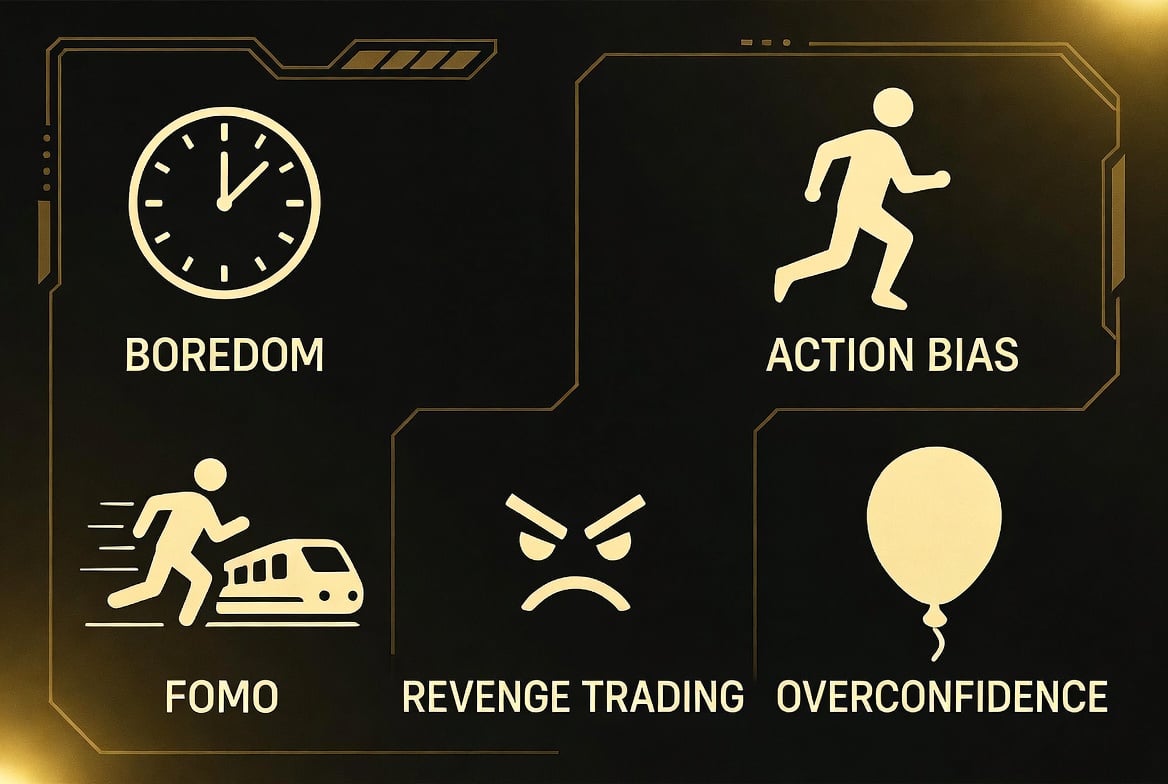
Understanding the psychology behind overtrading is the first step to overcoming it.
Boredom
The market is open. You're watching. Nothing is happening. Your brain whispers: "You should be doing something."
So you trade—not because there's a valid setup, but because you're bored.
Action Bias
Humans have a documented bias toward action. Doing something feels better than doing nothing, even when nothing is the correct choice.
In trading, this manifests as forcing trades that don't meet your criteria.
Fear of Missing Out (FOMO)
The market moved without you. You missed it. Your brain screams: "Don't miss the next one!"
So you enter the next thing that moves, regardless of whether it qualifies as a valid setup.
Revenge Trading
You lost money. You want it back immediately. So you trade again, and again, trying to recover what the market "took" from you.
Overconfidence
You're on a winning streak. You feel invincible. "I'm hot right now. I should trade more to maximize this run."
This is typically when the market delivers a humbling lesson.
The Quality Framework
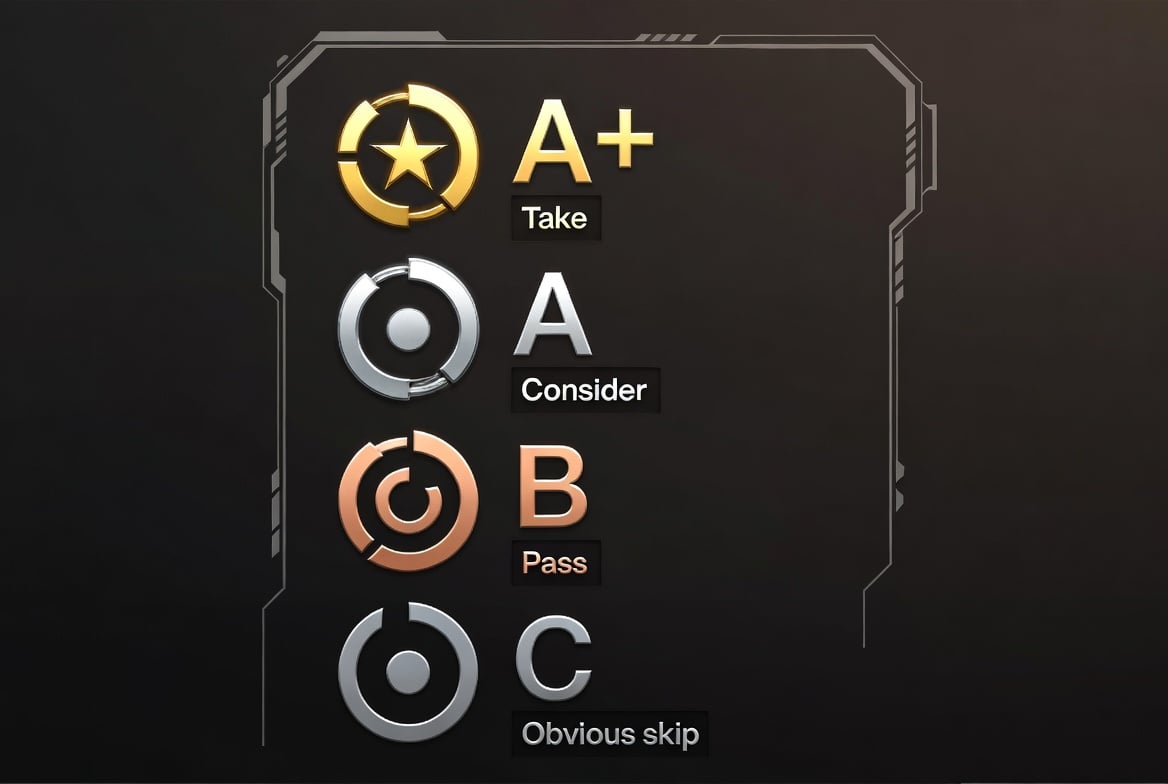
The solution to overtrading isn't willpower—it's a framework that makes selectivity systematic.
Setup Grading System
Not all setups are equal. Grade yours:
A+ Setup: Perfect alignment. All criteria met. High conviction. This is what you're waiting for.
A Setup: Strong alignment. Most criteria met. Good conviction. Worth considering.
B Setup: Decent alignment. Some criteria met. Moderate conviction. Looks like an opportunity but isn't.
C Setup: Weak alignment. Few criteria met. Low conviction. Should be obvious to skip.
The Rule: Only trade A+ setups. Let everything else pass.
This sounds simple. In practice, it's challenging. B and C setups still look like opportunities. They still trigger FOMO. But the data typically shows that A+ setups have significantly higher win rates than lower-grade setups.
The 80/20 Rule in Trading
In most trading accounts, approximately 80% of profits come from 20% of trades.
This means most trades are noise. A small minority are signal.
The goal isn't to trade more—it's to identify and take only the trades that matter.
Opportunity Cost Thinking
Before every trade, ask: "Is this the best use of my capital right now?"
If you take a B setup, that capital is committed. When the A+ setup appears, you might lack the capital—or the mental bandwidth—to take it.
Patience as Active Skill
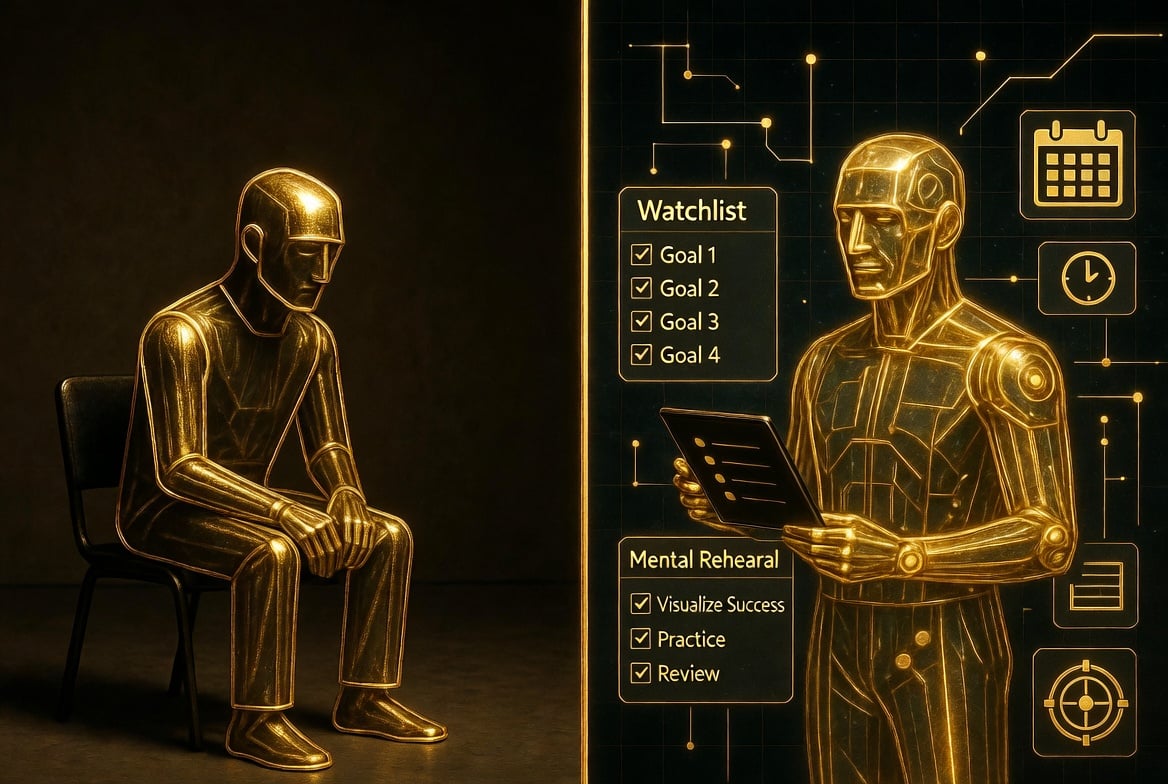
Here's the critical mindset shift: patience isn't passive waiting. It's active preparation.
Watchlist Management
While waiting, you're not idle. You're:
- Monitoring your watchlist for developing setups
- Identifying potential opportunities
- Preparing for when conditions align
This is productive work. It's just not trading.
Mental Rehearsal
Visualize your perfect entries. When the setup appears, you've already "traded" it mentally. Execution becomes automatic rather than hesitant.
Alternative Activities
What do you do while waiting?
- Review past trades for patterns
- Study market structure
- Work on system refinement
- Exercise or take breaks
- Live your life outside trading
Waiting doesn't mean staring at charts. It means being ready when the setup comes.
Patience Metrics
What gets measured gets managed. Track your patience systematically.
Trades Per Week
Set a target—not a minimum, but a maximum.
If your system generates 5-10 A+ setups per week, your target might be 5-10 trades per week. More than that suggests you're taking lower-grade setups.
Win Rate by Setup Grade
Track win rate separately for A+, A, B, and C setups.
You'll likely find that A+ setups have significantly higher win rates. This data reinforces the discipline to wait.
Patience Score
Create a simple metric:
Patience Score = (A+ trades taken) / (Total trades taken)
A score of 0.8 means 80% of your trades were A+ setups. Track this weekly and aim to improve.
The Paradox of Patience
Here's the counterintuitive truth: the less you trade, the more you typically make.
Why?
- Better entries: Selectivity means entering only at optimal prices
- Lower costs: Fewer trades mean fewer commissions, spreads, and slippage events
- Better decisions: Less decision fatigue means higher quality choices
- Emotional stability: Fewer trades mean less emotional volatility
- Capital preservation: Not trading is the ultimate risk management
"The stock market is a device for transferring money from the impatient to the patient." — Warren Buffett
Practical Implementation
Step 1: Define Your A+ Setup
Write down exactly what makes a perfect setup for your system. Be specific:
- What indicators must align?
- What price action must occur?
- What volume characteristics are required?
- What market conditions must be present?
If you can't define it precisely, you can't wait for it effectively.
Step 2: Set a Trade Limit
Start with a maximum trades per day or week. This forces selectivity.
If you can only take 2 trades per day, you'll naturally wait for the best ones.
Step 3: Create a Waiting Routine
Define what you do while waiting:
- Morning: Review watchlist, identify potential setups
- During session: Monitor without forcing
- End of day: Review what you waited for and what you passed on
Step 4: Track and Review
Weekly, review:
- How many trades did you take?
- What percentage were A+ setups?
- What was your win rate by setup grade?
- Did you overtrade? What triggered it?
Key Takeaways

Overtrading has hidden costs. Beyond commissions, there's decision fatigue, emotional drain, and opportunity cost.
Most profits come from few trades. The 80/20 rule applies—focus on the trades that matter.
Grade your setups. A+/A/B/C system makes selectivity systematic rather than emotional.
Only trade A+ setups. Let everything else pass, regardless of FOMO.
Patience is active, not passive. Use waiting time for preparation, not idle chart-watching.
Track patience metrics. Trades per week, win rate by grade, patience score.
The best traders trade less. Quality over quantity is the sustainable edge.
Frequently Asked Questions
How do you know if you're overtrading?
Track your trades per week and compare to your system's expected setup frequency. If your system generates 5 A+ setups per week but you're taking 20 trades, you're overtrading. Also compare win rates by setup grade—if lower-grade setups have significantly worse performance, you're taking trades you shouldn't.
What if you miss a good setup while waiting?
You will miss setups. This is guaranteed. But the setups you miss by waiting are typically offset by the bad trades you avoid. The goal isn't to catch every move—it's to catch the best moves with the highest probability.
How do you handle boredom while waiting?
Reframe waiting as active preparation rather than passive idleness. Use waiting time for watchlist management, trade review, system development, or non-trading activities. If you're bored, you're probably watching charts too intensely.
Is there such a thing as trading too little?
Yes, if you're missing valid A+ setups due to fear or analysis paralysis. The goal is to take all A+ setups and no B/C setups. Track whether you're missing setups you should have taken.
How long does it take to develop patience?
Patience is a skill that develops over months, not days. Most traders see improvement within 2-3 months of consistent practice with setup grading and trade limits. Like any skill, it requires ongoing attention.
What if your system requires more trades?
Some systems (like scalping) require higher trade frequency. The principle still applies: only take setups that meet your criteria. Even high-frequency traders can overtrade by taking setups that don't qualify.
Conclusion
The market rewards patience. It punishes impatience.
The best traders share one trait: they trade less than you'd expect. They're not constantly in the market. They're not catching every move. They're waiting—actively, patiently—for the setups that matter.
"The desire to perform all the time is usually a barrier to performing over time." — Robert Olstein
Your edge isn't in trading more. It's in trading better. And trading better often means trading less.
Define your A+ setup. Set a trade limit. Track your patience. Watch your results improve.
Related Articles: