Trading Journal Mastery: The Psychology Behind Effective Trade Logging
Master trading journal psychology with our complete guide. Learn what to track beyond P&L, how to review for patterns, and build a journaling habit that sticks.
Profabighi Capital Research Team
January 10, 2026
Important Notice
This content is provided for informational and educational purposes only. It should not be considered as financial, investment, or trading advice.

Many traders think trading journals are a waste of time. "I remember my trades," they tell themselves. "I know what I did wrong." They make money some months, lose it others, but can't figure out why. They blame the market. They blame their strategy. They blame bad luck.
Then, during a particularly brutal losing streak, a simple question changes everything: "What patterns do you see in your losing trades?"
Without a journal, there's nothing. No data. No patterns. Just vague memories and excuses.
Here's what traders discover when they start keeping a trading journal: patterns that have been costing them thousands of dollars—patterns so obvious in hindsight that they can't believe they missed them.
Common discoveries include:
- Consistently overtrading on Mondays (significantly lower win rate vs. the rest of the week)
- Giving back entire week's profits in a single day, every single week
- Emotional trades after 2 PM performing significantly worse
You would never find these patterns without a trading journal.
Why Most Traders Don't Journal (And Why They Should)
Let's be honest: journaling feels like homework. After a trading session, the last thing you want to do is write about it. Especially after a losing day.
But here's what research shows: the resistance to journaling is often proportional to how much you need it.
The Three Common Excuses
Excuse 1: "I don't have time"
A minimum viable journal entry takes 60 seconds. If you have time to trade, you have time to journal. The real issue isn't time—it's discomfort with self-examination.
Excuse 2: "I remember my trades"
Research shows that memory is reconstructive, not reproductive. You remember a story about your trades, not the actual trades. And that story is biased toward making you look better than you were.
Excuse 3: "I tried it and it didn't help"
This usually means one of two things: you were tracking the wrong things, or you weren't reviewing your journal. Recording without reviewing is like taking notes in class and never studying them.
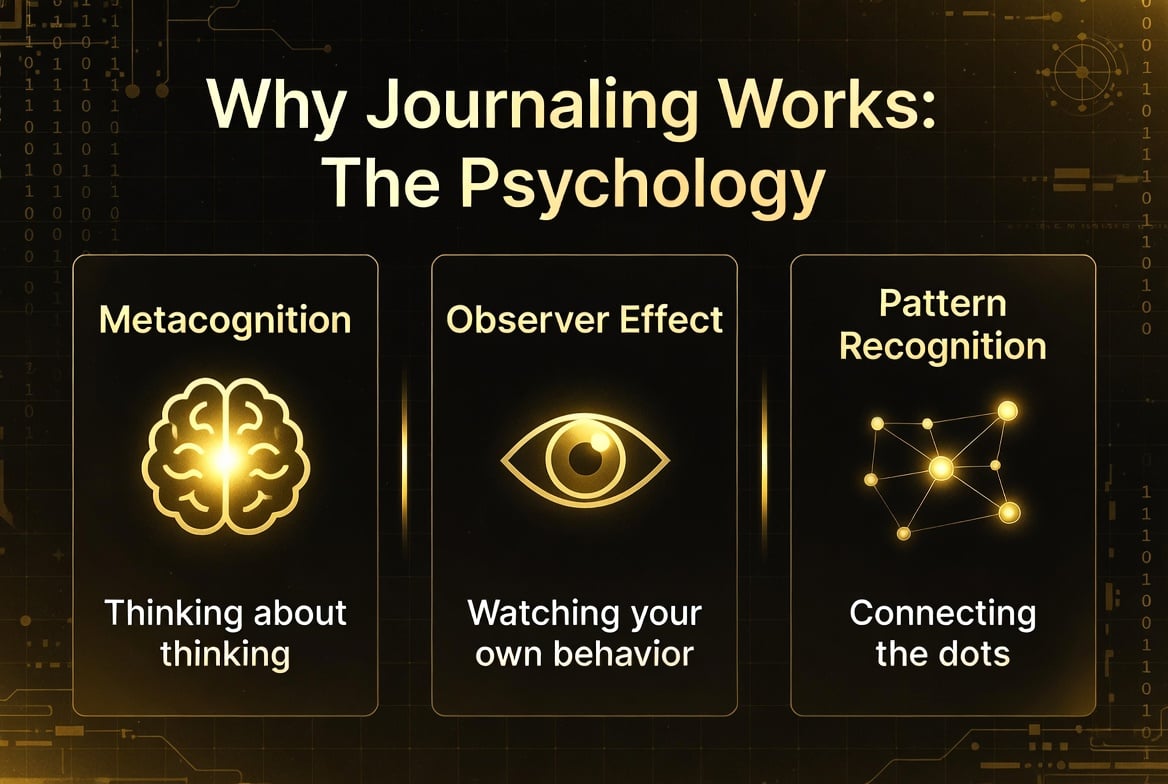
Why Journaling Works: The Psychology
Trading journals aren't just record-keeping. They're psychological tools that work on multiple levels.
Metacognition: Thinking About Your Thinking
When you journal, you engage in metacognition—the process of thinking about your own thought processes. This is the foundation of self-improvement.
"The unexamined life is not worth living." — Socrates
In trading terms: the unexamined trade is not worth taking. If you can't articulate why you took a trade, you can't learn from it.
The Observer Effect
Here's something fascinating: the act of knowing you'll journal a trade changes how you trade.
When you know you'll have to write down "I took this trade because I was bored," you're less likely to take that trade. The journal creates accountability, even when no one else reads it.
Pattern Recognition Over Time
Your brain is terrible at recognizing patterns in your own behavior. We're wired to see ourselves as consistent, rational actors. We're not.
A journal externalizes your decisions, making patterns visible that your brain would otherwise hide from you.
"What gets measured gets managed." — Peter Drucker
What to Track Beyond P&L

Most trading journals focus on the wrong things. They track entry price, exit price, profit/loss, maybe a chart screenshot.
This tells you WHAT happened. It doesn't tell you WHY.
Category 1: Emotional State
Before the trade:
- How did you feel? (1-10 scale: 1=fearful, 5=neutral, 10=euphoric)
- What was your confidence level in this setup?
- Were you influenced by recent wins or losses?
During the trade:
- Did your emotional state change?
- Did you feel the urge to move your stop?
- Were you watching the trade obsessively?
After the trade:
- How do you feel about the outcome?
- If it was a loss, are you tempted to revenge trade?
- If it was a win, are you tempted to oversize the next trade?
Category 2: Decision Process
- Why did you take this trade? (Be specific)
- Did it match your trading plan criteria?
- What was your edge in this trade?
- If you deviated from your plan, why?
Category 3: External Factors
- How much sleep did you get?
- Are you stressed about non-trading issues?
- Did news or social media influence this trade?
- What time of day was it?
Category 4: Lessons Learned
- What would you do differently?
- What did you do well?
- Is there a pattern here you've seen before?
The Review Process: Where the Magic Happens
"Keep a trading journal. It's the single most important thing you can do to improve." — Brett Steenbarger

Recording trades is 20% of the value. Reviewing them is 80%.
Daily Review (5 minutes)
At the end of each trading day:
- Complete your journal entries for the day
- Rate your overall discipline (1-10)
- Note one thing you did well
- Note one thing to improve tomorrow
Weekly Review (30 minutes)
Every weekend:
- Calculate your weekly statistics
- Look for patterns in winning vs. losing trades
- Review your emotional state entries—any correlations?
- Identify your best and worst trade of the week
- Set one focus area for next week
Monthly Deep Dive (2 hours)
First weekend of each month:
- Comprehensive statistics review
- Pattern analysis across all four categories
- Compare this month to previous months
- Identify your top 3 recurring mistakes
- Create specific rules to address those mistakes
Quarterly Strategy Review (Half day)
Every three months:
- Is your edge still working?
- What patterns have emerged over 3 months?
- What rules have you added or modified?
- Are you improving? (Compare quarters)
The Minimum Viable Journal

If you're not journaling at all, don't start with a complex spreadsheet. Start with the minimum viable journal.
The 3-Question Journal
After every trade, answer three questions:
- Why did you take this trade? (One sentence)
- How did you feel? (One word: confident, uncertain, fearful, greedy, bored)
- What did you learn? (One sentence)
That's it. Three questions. Takes 60 seconds.
Once this becomes a habit (usually 2-3 weeks), you can expand.
Building the Habit
The best way to build a journaling habit is to attach it to an existing habit. This is called "habit stacking."
Example stack:
- Close your trading platform (existing habit)
- Open your journal (new habit)
- Answer the 3 questions (new habit)
- Close your journal (new habit)
- Stand up and stretch (existing habit)
The key is making journaling part of your trading routine, not a separate activity.
Common Journaling Mistakes to Avoid
Mistake 1: Too Complex, Too Soon
Starting with a 50-field spreadsheet is a recipe for abandonment. Start simple, add complexity only when you've proven you can maintain the habit.
Solution: Begin with 3 questions. Expand after 30 days of consistency.
Mistake 2: Only Journaling Losses
Some traders only journal when they lose. But you learn just as much from wins—especially wins from following your process vs. wins from luck.
Solution: Journal every trade, win or lose.
Mistake 3: Recording Without Reviewing
A journal you never review is just a diary. The insights come from review, not recording.
Solution: Schedule reviews like you schedule trades. Put them in your calendar.
Key Takeaways
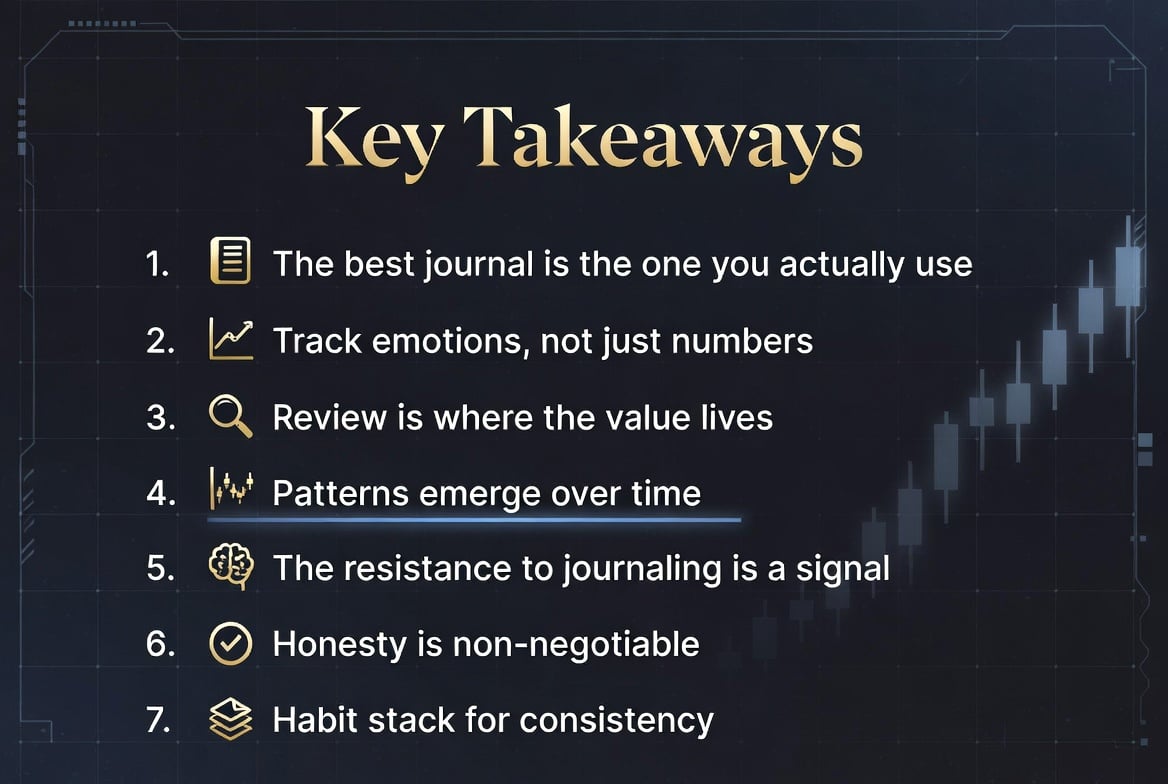
The best journal is the one you actually use. Start simple. A notes app beats an abandoned spreadsheet.
Track emotions, not just numbers. Your P&L tells you what happened. Your emotional notes tell you why.
Review is where the value lives. Recording without reviewing is pointless. Schedule your reviews.
Patterns emerge over time. Give it at least 100 trades before judging effectiveness.
The resistance to journaling is a signal. The days you don't want to journal are the days you need it most.
Honesty is non-negotiable. A dishonest journal is worse than no journal.
Habit stack for consistency. Attach journaling to your existing trading routine.

Frequently Asked Questions
What's the best trading journal template?
The best trading journal template is the one you'll actually use consistently. Start with a simple notes app or basic spreadsheet with 3-5 fields. Complex templates with 50+ fields often get abandoned within weeks. Focus on tracking emotional state, decision process, and lessons learned—not just P&L.
How long does it take to see patterns in your journal?
Most traders start seeing meaningful patterns after 50-100 journal entries. Your first 50 trades are data collection. The next 50 are where patterns become visible. Give yourself at least 2-3 months of consistent journaling before judging whether it's "working."
Should you journal every trade or just the important ones?
Journal every trade. You learn as much from small wins and losses as from big ones. More importantly, the trades you consider "unimportant" often reveal patterns—like overtrading or taking low-quality setups. Selective journaling creates blind spots.
What if you don't have time to journal?
The minimum viable journal takes 60 seconds per trade: one sentence for why you took it, one word for how you felt, one sentence for what you learned. If you have time to trade, you have time for 60 seconds of reflection. The real barrier usually isn't time—it's discomfort with self-examination.
How do you stay consistent with journaling?
Use habit stacking: attach journaling to an existing habit in your trading routine. For example, immediately after closing your trading platform, open your journal. Make it the bridge between trading and your next activity. Also, start simple—complexity kills consistency.
What's the difference between a trading journal and a trading log?
A trading log records what happened: entry, exit, P&L. A trading journal records why it happened: emotional state, decision process, lessons learned. Logs tell you the outcome. Journals help you understand the cause. Both are valuable, but journals drive improvement.
Can you use a trading journal app instead of a spreadsheet?
Absolutely. The format matters less than consistency. Apps like Tradervue, Edgewonk, or even a simple notes app work well. Choose whatever reduces friction and increases the likelihood you'll actually use it. Some traders prefer paper journals for the tactile experience.
Conclusion
Trading journals aren't about record-keeping. They're about self-discovery.
The patterns hiding in your trading—the Monday overtrading, the post-win oversizing, the afternoon fatigue—are invisible without external data. Your brain won't show them to you. It's too busy protecting your self-image.
A journal forces honesty. It creates accountability. It reveals the truth about your trading that you can't see any other way.
Start simple. Three questions. Sixty seconds. Build the habit first, then expand.
"The goal of a successful trader is to make the best trades. Money is secondary." — Alexander Elder
Your journal helps you make better trades. The money follows.
Related Articles
- Risk Psychology: Why You Break Your Own Rules
- The Daily Trading Ritual: Building Routines That Stick
- The Discipline Equation: Systems Over Willpower
- The Stoic Trader Framework: Ancient Philosophy for Modern Markets
- Fear & Greed Mastery